
Now We will see the new model of i-phone its called i-phone 5........ will launch soooooooon.
Its better then i-phone 4.

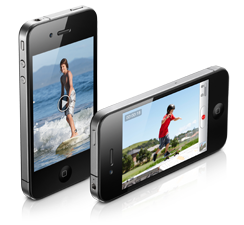 Face Time
 Retina Display
What a bittersweet experience. When you first lay eyes on the Desire, you'll love the screen. Your home screens and the live backgrounds of Android 2.1 look absolutely gorgeous. It's once you start viewing photographs and watching video that the shortcomings of the AMOLED technology used in the Desire become apparent.
For some in-depth information about the shortcomings of the AMOLED screen, check out Ars Technica and Display Mate. Both articles are talking about the Nexus One's display, but it's the same display used in the Desire.
Just...wow. I only need two words to describe the X10's screen - massive and gorgeous. You're not going to find greater pixel density outside of HTC's Windows Mobile devices. No matter what you're looking at - webpages, photos, video - it looks absolutely amazing.
The Xperia X10 is certainly an eye catching design, but once you're holding it, it loses a lot of the magic. Putting such impressive specifications inside such a plasticy case was a bad move - especially with the price tag they've slapped on it.
The Desire departs from the HTC look we're used to. That trademark chin is still there, but it's much more subtle. The optical trackball is certainly much nicer than the physical trackball of the HTC Hero, but I'd still rather use the touchscreen.
My first experience with a custom user interface running on top of Android was HTC's Sense UI running on the HTC Hero, and I loved it. The Sense UI is back on the Desire, and it's badder than ever. There's seven home screens to customize as you see fit, and you can pinch to zoom out and see thumbnails of all seven screens, and quickly jump to the screen you want. There's HTC widgets and Android widgets displayed in a unified interface, and HTC are able to release new widgets for download without updating the operating system.
Having experienced the dry look and feel of pre-2.0 Android, I can't fault Sony Ericsson's decision to create a custom UI to place on top of Android 1.6... but I can fault the execution, which manages to make a blazing fast 1GHz processor feel rather inadequate, and a whopping 4-inch screen seem too small. Portions of the UI seem like they've been designed specifically to waste all that real estate.
I'd initially thought that a 1GHz processor would be ample grunt for a smartphone to do just about anything, but the differing performance of these two phones has proved otherwise. I'm sure you've seen those TV ads for phones where everything is fluid and instant, even when the real world performance is far from it. Well, the HTC Desire is as close to that magical "ad phone" I've ever seen, whereas the Xperia has some serious performance issues.
This is probably not so surprising, given that HTC has had a long time to polish the Sense UI over multiple devices, and Sony Ericsson has tried to do something fairly ambitious straight out of the gate with their user experience, biting off more than they could chew in the process.
HTC's social media software, FriendStream, is functional enough, but it needs a couple of UX tweaks. The ability to view only Facebook updates or Twitter updates on their own would help, and it would be nice to be able to click links in tweets directly from the widget, rather than click on the tweet for the expanded view in HTC's Twitter client, Peep, before being able to click on the link.
Linking your contacts to their Facebook and Twitter profiles works beautifully, and flags potential matches for you which makes the initial setup much less painful.
Sony Ericsson's social media software, Timescape, represents form over function at its finest... and the form isn't even that good. Feeds from your various social networks are displayed in "splines", which makes sense, but you can only see an average of four or five words from each status update, and profile pictures that look gorgeous in even the most barebones Twitter clients are stretched and warped beyond recognition. You can't even visit links in tweets - clicking them takes you to that user's profile on mobile.twitter.com site, which is totally unintuitive. I do have to give Sony Ericsson props for understanding that Twitter and Facebook are often different worlds, and you might only want to view messages from one of those services at a time.
Given Timescape is designed for socialites, I'm surprised there's no option for more frequent updates. The shortest update frequency for Twitter is 5 minutes, and Facebook is 1 hour. This is exacerbated by the fact that when it does pull new data, the updates are put into the spline one at a time, so the spline just keeps scrolling and scrolling - and you can't stop it from doing so if you see something interesting.
You can supposedly link your contacts to their social media profiles, but I never got it to do anything other than place a link to someone's Facebook profile from their contact.
Both HTC and Sony Ericsson have quite a way to go before you can use one of these phones without a dedicated Twitter client (we recommend Twidroid) and the official Facebook application. Apple looks set to launch Facebook integration in iPhone OS 4.0, so we hope this spawns a new lot of innovation in this space.
While the X10 has an extra 100mAh up its sleeve compared to the Desire's 1400mAh battery, it's really splitting hairs to find a winner in terms of real life usage.
With 3G enabled, Gmail syncing and Twidroid updating in the background, both phones had about 40% left on the battery after 24 hours. That's nowhere near Nokia or BlackBerry levels of standby battery life, but it's impressive nonetheless - if you forget to charge either of these phones overnight, you'll have ample charge left to make it to the office the next day.
Sometimes it's easy to forget that we buy these devices primarily to use as a telephone. The X10 has a couple of issues - the earpiece is a bit on the quiet side, so if you're the kind of person who finds yourself trying to communicate in noisy bars and clubs you might have some issues with it. More importantly, there's some bizarre software glitches that cause the phone to forget about missed calls and text messages - which is definitely not ideal.
The HTC Desire is definitely the most comfortable "slab of glass" style phone I've ever used. The rounded shape at the top is so much nicer on the ear than the metal rim of the iPhone or the plastic rim of the X10.
The HTC Desire is multitouch enabled, with pinch zoom in the browser and Google Maps providing a far superior user experience to the multitouch-less X10. The Desire's touchscreen is also far more responsive than that of the HTC Hero. Interestingly, there's conflicting information about whether multitouch is coming to the X10 when it's updated to Android 2.1 or 2.2 later this year.
Both these phones are head to head in terms of media support, but that's not to say either is particularly impressive. DivX and FLAC support would be an easy way to win the hearts of media junkies, so it's surprising to see that neither of these phones have done so.
The X10 puts the emphasis on Recently Played, Recently Added and Favorite media. You have to click "More" to get to the standard list of media. That might work for some, but not me - only my favorite media makes it onto my microSD card in the first place. The transitions and animations end up detracting from the usability - I just want a fast way to navigate through what's on there, not eye candy.
The Desire is as close to the iPhone/iPod touch as you're going to get outside Apple land. Navigating the menus is intuitive and very fluid, and you can create playlists on the device. At Mobile World Congress, HTC announced that the Desire would be getting DivX support in a future update, but neglected to mention when that update might be hitting devices.
The X10 has such potential. If Sony Ericsson could iron out the kinks in their software, and improve format support with FLAC and DivX support, it'd be a hard one to beat in terms of media, but as it stands, it's really hard to recommend - the first thing I'd do if I bought one would be install a vanilla Android 2.1 ROM.
If you haven't figured it out by now, the HTC Desire is the clear winner of this shootout. Despite the shortcomings of the AMOLED screen, it's by far the nicest Android phone I've ever used. If you want an Android phone today, this is what you should be buying.

We've all been there - you're trying to communicate with someone who doesn't speak your language and you don't speak theirs, and no amount of charades and gesturing will do the trick. You need a toilet and he's wondering why you're telling him your brother eats flies. Converse is the name of a new app that will soon become available which is claimed to turn your iPhone into a double ended language translator – a multilingual, face-to-face instant messaging conversation. It's one of the most innovative uses of the iPhone's form factor we've yet seen, with both people able to type on a keyboard in their own language at the same time and have the words translated and displayed for the other person. If it works as advertised, Converse is set to significantly reduce communication problems on holidays and business trips. The new app enables an English speaker to communicate with people in 51 different languages and keyboards accommodate non-Latin languages such as Arabic, Chinese, Japanese, Korean, Russian, Thai, Czech, Hebrew and Ukrainian scripts.
You can ask a question by simply typing it in, just like a text message or email. The text is then immediately translated into your chosen language and displayed on the other end of the screen. The person can then respond to the question in their language in exactly the same way and their response is translated, then displayed to you in the Queen's English.
This novel twist on language translation is claimed to use “the best language translation APIs available on the web” and enable “fluent complex text-based conversations with almost anyone in the world.” Now if you've ever played with web translation, you'll know this is a big claim, but with a price of just GBP1.79, even if it's only half that good it'll have a nuclear level bang-per-buck factor as translation apps are among the highest priced apps in the iTunes store. Whatsmore, the convenience of having a single word or phrase translator for rough and ready translations on the go will be simply too good to pass up.


Since early December 2009, consumers have been tantalized with news of the upcoming release of the ASUS Eee keyboard PC – a keyboard with all the functionality of a netbook. It seems they won’t be left waiting for too much longer. ASUS announced at CES 2010 that the Eee keyboard should be available sometime in the first quarter of 2010.
Touchscreens found in most mobile devices today use capacitance or resistance technology - fine for detecting input from a finger, but not so great when it comes to detecting how much pressure that finger is applying. However, this limitation could be about to change with news that Japanese touch screen manufacturer, Nissha, has licensed new technology that allows a touchscreen to detect pressure, even from a finger. This adds a third dimension to touchscreen interaction and opens up a raft of potential applications.
The licensing agreement conc

Handset manufacturer i-mate’s 810-F is so tough the company has given it a lifetime year-on-year warranty. That’s because it has already put the 810-F through a grueling set of tests and trials, including running a car over it, immersing it in all kinds of fluids, kicking it, dropping it, baking it, freezing it and even calling it bad names – and yet the device continues to work. I-mate says the 810-F has even passed the rigors of US Military toughness specifications (standards as referenced for impact resistance, crush force, submersion, rain/mist/salt, fog, dust ingress, and vibration).
Think of a challenge for the 810-F and it has probably already passed it, which makes it ideal for mere mortals such as contractors on work sites, outdoor adventurers like hikers, skiers and surfers – and basically anyone who has found that off-the-shelf handsets are too easily damaged.

Last December, the world was introduced to the Synaptics Fuse, a new concept in mobile communications. The prototype smartphone is the result of a collaboration between Synaptics, Texas Instruments, Immersion, TheAlloy and The Astonishing Tribe (TAT). What makes this phone so special is its user/phone interface. It takesSynaptics’ pioneering touchscreen technology to a whole new level, allowing people to use the phone one-handed, and without having to even see the screen.


This week at the Consumer Electronics Show in Las Vegas, Palm unveiled its two upcoming Verizon-exclusive smartphones, the Pre Plus and the Pixi Plus. Both phones boast substantial improvements over their present namesakes, and both will utilize Palm’s new webOS developer program, which will allow independent software developers to create and distribute their own apps.
The Palm Pre Plus has twice the memory of the current Pre, a Touchstone charging dock-compatible back cover, and an overhauled design. Like the current Pre, it still features a full slide-out keyboard.
The most notable new feature on the Palm Pixi Plus is its WiFi connectivity. Via an upcoming software update, both phones will now be able to shoot and edit video, and with an Adobe Flash plug-in, they will also be able to run streaming video directly off the web.

Google sees a future where carriers have to compete on price and the quality of their networks, rather than exclusive deals with handset manufacturers like AT&T's lengthy exclusive deal with Apple for the iPhone and subsequent models. The Nexus One is its first baby step toward that future and it's currently available in unlocked form to consumers in the US, UK, Singapore and Hong Kong for US$529. If for some reason you want to be locked into a contract, the only option is T-Mobile, with the phone available for $179 with a two-year contract, with Verizon (US) and Vodafone (EU) options available in the not-too-distant future.
Andy Rubin, VP of Engineering at Google, refers to the Nexus One as a "superphone" due to the 1GHz Qualcomm Snapdragon CPU inside. To put this intosome perspective, the Motorola Droid, iPhone 3GS and the Palm Pre all use a 600MHz Arm Cortex A8 CPU. I say some perspective due to the lesson that Intel taught us with the Pentium 4 - clockspeed doesn't mean everything.

If you've ever lost your phone without having a backup of your contacts, you'll know what a painful experience it is. Enter IDrive Lite, a free service that allows you to backup the contacts on your phone into the cloud. Previously available for iPhone and BlackBerry, it's finally made its way to Android.
While Android already stores your contacts in Google's cloud, there's benefits to using IDrive Lite - support for multiple accounts, a nicer web interface to manage your contacts, the ability to selectively restore contacts, and import contact details from Facebook, and of course, for those of you who juggle multiple phones, support for iPhone and BlackBerry.
Unfortunately, IDrive Lite is only available for Android 2.0 and higher - which rules out a significant chunk of the Android userbase at this point in time - but you can't argue with the price.
Of course, this is assuming that the reason you aren't backing up right now is price rather than sloth.

The advent of ever-more sophisticated software being at our immediate disposal via smart phones will continue to transform our lives in many ways, some we probably haven't even considered prior to now. The USD$5.99 iSwing iPhone application allows users to record their golf swing on video and replay it frame-by-frame in slow motion and analyze their flaws by drawing lines over their screen to make sure they’re “on-plane.” This swing analysis application represents remarkable value, given that professional swing analysis usually costs USD$60 a visit. Coming soon on Android too.
The creation of mobile software company, Keuminotti, iSwing also creates sequence photos like Golf Digest centerfolds that can be used as a virtual reference, or that you can share with friends via Facebook Connect. The iSwing sells for $5.99 and is offered for the iPhone 2G, 3G & 3GS.
After 8 months of research, development, and beta testing, the iSwing hit the App Store this August. Since it’s debut, the iSwing has already broken into the top 5 most downloaded apps in Japan Sports and stands currently at #1 in Korea Sports. “The success we’ve seen in Asia is translating well to the US where golf can be an expensive pastime. Professional swing analysis can cost an average of $60 per visit. And for the price of a bucket of range balls, one can analyze their swing on a device they already carry in their pocket…”, says Charlie Keum, CEO and Founder ofiSwing.
Note that iSwing is also the name of a Toyota Personal Mobility Concept.

The holidays might be over now, but the rumors regarding Apple's iSlate tablet device certainly aren't. Read on for a roundup of the latest rumors, including announcement dates, release dates, screen sizes and pricing.
Sources have told AllThingsD that Apple will unveil a "major new product" at the Yerba Buena Center for the Arts in San Francisco on Wednesday the 27th of January.
According to the Wall Street Journal, the device will cost $1,000, feature a "10 to 11-inch touch screen" and will be unveiled later this month, with shipping to commence in March.
French site Mac4Ever claims that Apple has seeded a beta of the iPhone OS 4.0 SDK to developers, including a simulator which allows the creation of interfaces for the new device's resolution and aspect ratio.


So If you've finally got your new iPhone. So its Good for you...because its charge with solar energy......This is new technology in i-Phones....
You stroke its sleek shiny lines and imagine it purrs seductively at you. Then the battery goes dead. The Solar Surge is designed to get you out of the bind. It's a lightweight slip-on solar panel that cleverly charges your iPhone 3G or 3GS and iPod Touch whenever there is enough sunlight available, making the hassle of charging on the go, well, no hassle at all really.
Energy from the sun is converted to reusable electricity via durable Photovoltaic cells in the skin. If the iPhone is already fully charged, energy is diverted to the internal reserve battery for future use and moved between these two sources as required. Additionally the skin is smart enough to charge whenever adequate sunlight is available and smart enough to stop charging when the thermal sensor suggests over-heating is a possibility. LED indicator lights are provided to show charge status, and if there is inadequate sunlight for charging you can always revert to the USB charger as a fallback.


